

Mastering Rental Property Depreciation
Tax changes require our attention as Florida landlords, especially with rental property depreciation. The bonus depreciation deduction under section 168(k) will drop from 80% to 60% in 2024 . This makes proper depreciation calculations crucial for our financial success.
Rental property owners should also watch out for the Net Investment Income Tax (NIIT). This 3.8% tax applies to net investment income or the excess of modified adjusted gross income above the threshold amount . South Florida’s competitive rental market makes accurate expense tracking essential .
Let me walk you through everything you need to know about calculating rental property depreciation as a Florida landlord. This guide covers establishing your property’s cost basis, recovery periods, proper tax return filing, and ways to avoid common mistakes. You’ll find practical, straightforward advice here.
This step-by-step approach will help you maximize tax benefits while staying compliant with current regulations. It doesn’t matter if you’re an experienced property investor or just bought your first rental property – you’ll find value in this information.
What Is Rental Property Depreciation?
Definition and purpose of depreciation
Rental property depreciation gives landlords a valuable tax deduction to recover their income-producing property’s cost through yearly tax deductions . The IRS spreads this deduction throughout what they call the property’s “useful life.” Residential rental properties have a 27.5-year useful life span .
The concept of depreciation recognizes that buildings and structures wear out as time passes. The IRS offers this tax benefit because structures deteriorate, even though properties might gain market value .
“Depreciation is often misunderstood by new investors,” notes Monty M., President of InvestPro Properties with 27 years of experience owning rental properties. “It’s not about tracking actual decline in your property’s market value—it’s a tax concept that allows you to recover your investment costs over time.”
Your annual depreciation deduction depends on three factors:
- Your basis in the property
- The recovery period (27.5 years for residential rentals)
- The depreciation method used
Note that you can’t depreciate land because it doesn’t wear out or become obsolete . You can only depreciate the part of your property that serves rental purposes .
Why depreciation matters for landlords
Landlords get their biggest tax advantage through depreciation. This benefit reduces taxable income without touching actual cash flow . Properties that barely make money can become profitable investments thanks to this tax benefit .
“I’ve seen countless Florida investors achieve positive cash flow primarily because of depreciation,” explains Lisa M., CFO with InvestPro Properties and over 32 years of real estate accounting experience. “For a $200,000 property (excluding land), that’s roughly $7,273 annually in tax deductions—money that stays in your pocket.”
The numbers tell a compelling story. A residential rental bought for $300,000 with $60,000 in land value lets you depreciate $240,000 over 27.5 years. This creates an annual deduction of about $8,727 .
Depreciation shapes long-term investment choices about refinancing and selling . Remember that selling triggers depreciation recapture, which the IRS taxes up to 25% on previous depreciation claims .
Florida-specific context for depreciation
Florida’s strong real estate market makes depreciation knowledge valuable for the state’s landlords. Many Florida markets see rental property prices around $400,000, which creates substantial yearly depreciation deductions .
Florida investors use the Modified Accelerated Cost Recovery System (MACRS) with the General Depreciation System (GDS) for straight-line depreciation . This gives equal deductions throughout the 27.5-year period.
Tax rules keep changing. Bonus depreciation under section 168(k) has started decreasing, which affects how Florida landlords plan their property improvements and taxes.
Florida’s zero state income tax makes federal depreciation benefits more valuable to local investors. Smart allocation between land and building value helps maximize these benefits while staying audit-proof .
When and How to Start Depreciating a Property
Tax benefits from rental property depreciation depend on knowing the exact time it starts. The purchase date isn’t always the starting point, and mistakes could result in lost deductions.
explained
The placed-in-service date marks the start of your depreciation period. The IRS states this happens when your property is “first placed in a condition or state of readiness and availability for a specifically assigned function” . This date lets you start claiming depreciation deductions on tax returns.
Your rental property must meet these three criteria:
- Habitability – The property must be in suitable condition for occupancy
- Availability – It must be advertised or otherwise made available for rent
- Functional readiness – All but one of these permits and approvals must be in place
“Many Florida investors mistakenly believe they can’t start depreciation until they’ve secured a tenant,” explains Monty M., President of InvestPro Properties with 27 years of experience. “In reality, depreciation begins when the property is ready and available for rent, even if it’s temporarily vacant.”
You can continue depreciating the property after a tenant moves out and you make repairs or install new carpet . The applies to residential rental property. The IRS treats this as occurring mid-month whatever day your property starts service .
Personal use vs. rental use
The IRS has specific rules for properties with both personal and rental use. Your property becomes a residence if you use it for personal purposes more than 14 days or 10% of the rental days at fair market value during the tax year .
Mixed-use scenarios require you to:
- Split expenses between rental and personal use based on days used for each purpose
- Keep deductible rental expenses below gross rental income
- Count personal use days including your use, family members, or anyone not paying fair market rent
“Florida’s vacation rental market often creates confusion about personal versus rental use,” notes Lisa M., CFO at InvestPro Properties with over 32 years of real estate accounting experience. “Even if you rent to relatives at fair market value but retain free access to the unit, those days count as personal use days for tax purposes.”
The entity level determines personal versus rental use rather than the owner level . This matters especially for partnerships and S corporations owning dwelling units in Florida.
Converting a primary home to a rental
Market conditions or relocation needs often lead Florida homeowners to convert their primary residence into rental property. A special basis rule affects your depreciation calculations during this transition.
Your original basis for depreciation equals the lower of:
- The property’s fair market value on the conversion date, or
- The property’s adjusted basis on the conversion date
The method and recovery period in effect during the conversion year must depreciate your property, not when you first acquired it . Recent residential rental conversions use the modified accelerated cost recovery system over 27.5 years.
The timing of major renovations needs careful planning. Completing improvements after the property becomes a rental service provides a higher depreciable basis. This approach can turn potential repairs into deductible expenses .
Listing advertisements, property management agreements, or rental applications help document the exact date your property became available to rent. This documentation starts your depreciation properly.
How to Calculate Rental Property Depreciation
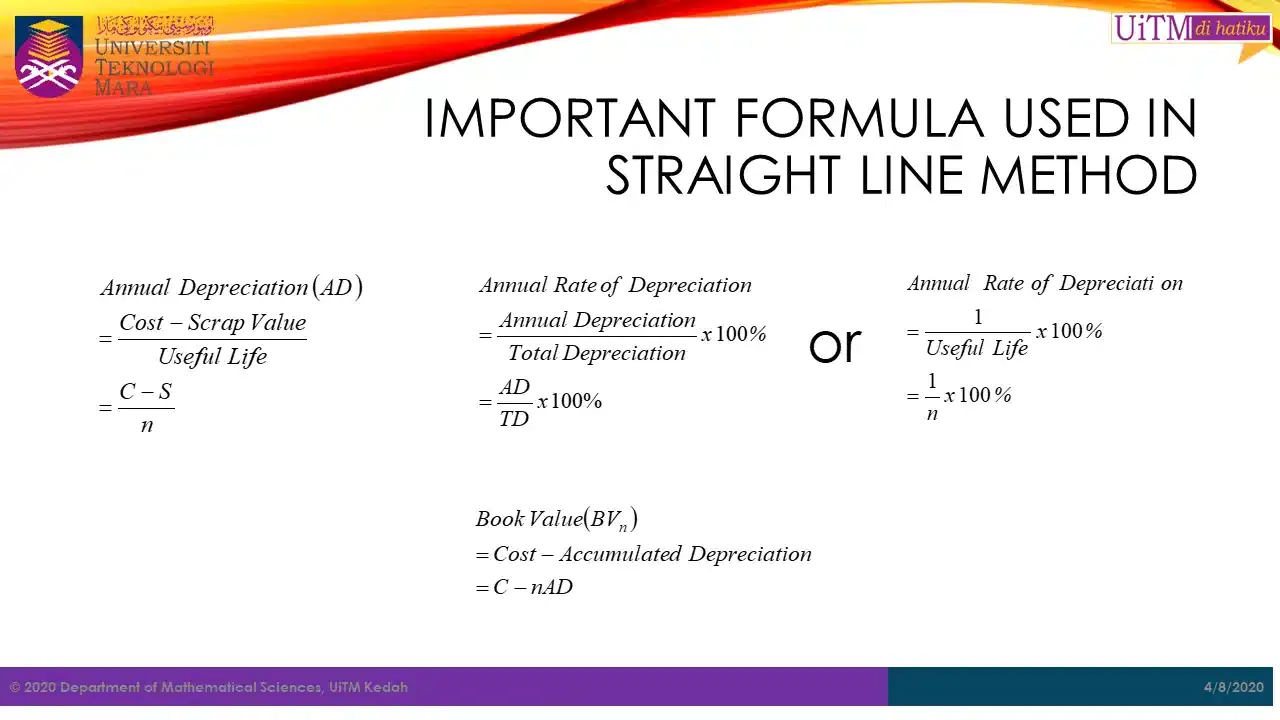
Image Source:
Rental property depreciation might seem complex at first. Breaking it down into systematic steps makes it more manageable. Let’s get into how to determine this valuable tax deduction for your Florida rental properties.
Step-by-step formula for straight-line depreciation
The IRS requires landlords to use straight-line depreciation for residential rental properties. This method splits the cost evenly over the recovery period . The simple formula is:
Annual Depreciation = Cost Basis ÷ Recovery Period (27.5 years)
Residential rental properties need a under the General Depreciation System (GDS) of the Modified Accelerated Cost Recovery System (MACRS) .
“Many landlords miss opportunities by not tracking their depreciation correctly,” notes Monty M., President of InvestPro Properties with 27 years of experience. “A simple spreadsheet tracking your annual depreciation can save thousands during tax season.”
Understanding cost basis and land value allocation
Your cost basis has:
- Purchase price
- Certain closing costs (legal fees, transfer taxes, title insurance, recording fees)
- Capital improvements before placing the property in service
Keep in mind that land value must be subtracted from your cost basis, as land cannot be depreciated . You can determine land value by:
- Checking your property tax assessment for the land-to-building ratio
- Getting a land appraisal
- Using comparable sales in your Florida neighborhood
“In South Florida markets like Palm Beach, ,” explains Lisa M., CFO with over 32 years of real estate accounting experience. “Accurate land allocation is critical—underestimating land value raises audit risk while overestimating reduces your depreciation benefits.”
Using MACRS and recovery periods
The IRS requires MACRS for most properties placed in service after 1986 . For residential rentals:
- Recovery period: 27.5 years (GDS) or 30 years (ADS)
- Convention: Mid-month (property treated as placed in service mid-month)
- Method: Straight-line (equal deductions across recovery period)
Example calculation for a Florida property
Let’s look at a Tampa rental property:
- Purchase price: $250,000
- Closing costs (qualified): $5,000
- Land value: $50,000
- Placed in service: March 15
Step 1: Calculate cost basis $250,000 + $5,000 – $50,000 = $205,000
Step 2: Calculate annual depreciation $205,000 ÷ 27.5 = $7,454.55 annually
Step 3: Apply mid-month convention for first year For March placement, multiply by 2.879% instead of full-year 3.636% First-year depreciation: $205,000 × 2.879% = $5,901.95
Using a rental property depreciation calculator
Online calculators make this process easier by automatically:
- Computing your annual depreciation expense
- Tracking accumulated depreciation over time
- Showing remaining basis each year
Online calculators need three key inputs:
- Cost basis (excluding land)
- Service date
- Property type (residential/commercial)
Filing Depreciation on Your Tax Return
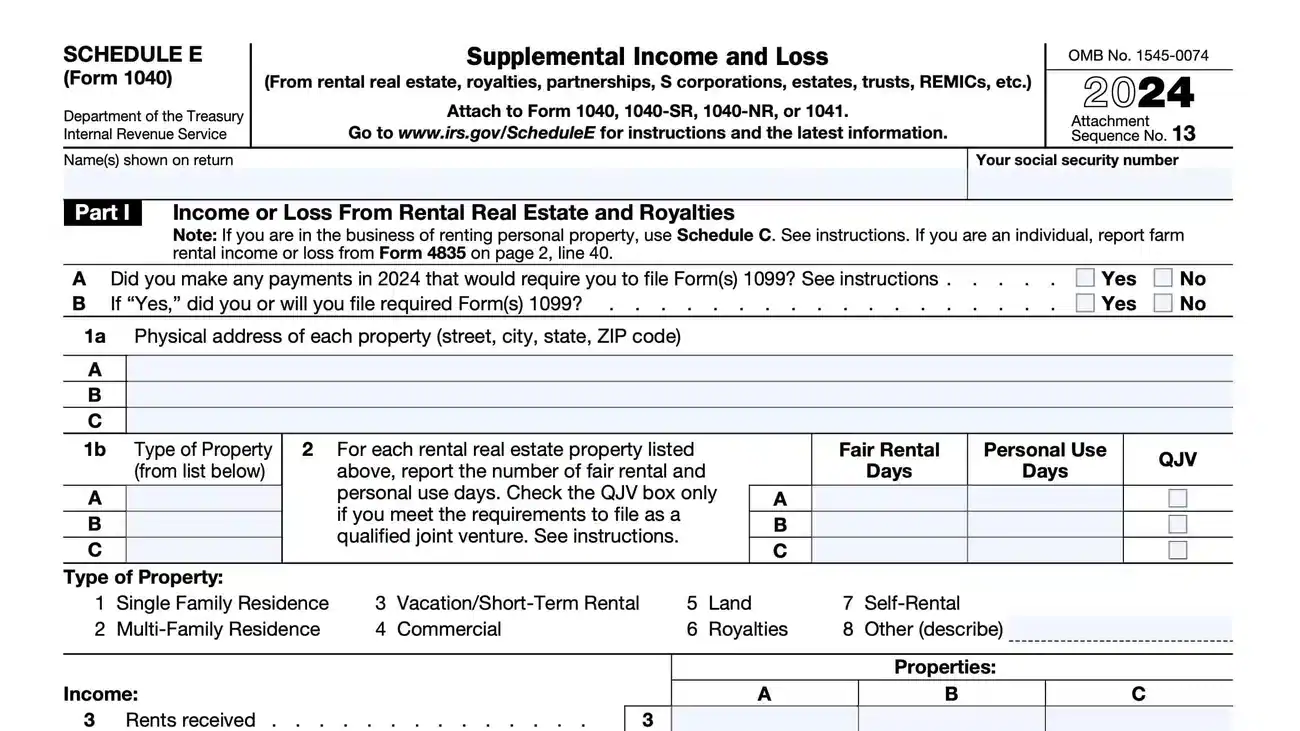
Image Source:
Tax benefits increase when you file your rental property depreciation correctly on tax returns. Florida landlords must follow specific IRS requirements to claim this valuable deduction.
How to report depreciation on
Schedule E (Supplemental Income and Loss) is where you report rental income and deductions, including depreciation . This form needs separate details about rental income and expenses for each property. New property owners must also file Form 4562 (Depreciation and Amortization) .
“Many Florida landlords don’t realize that depreciation is mandatory, even if you choose not to claim it,” explains Monty M., President of InvestPro Properties with 27 years of experience. “The IRS will still assume you’ve taken the deduction when calculating depreciation recapture taxes upon selling the property” .
Overview of IRS Publication 527
IRS Publication 527 (Residential Rental Property) provides complete guidance on rental property taxation . This important resource covers:
- How to recover costs through yearly depreciation deductions
- The three factors determining depreciation amounts
- Which forms to use for reporting
- Special rules for rental property improvements
Common mistakes to avoid
Your depreciation claims can get pricey with these errors:
- Failing to separate land value from the building’s value (land cannot be depreciated)
- Starting depreciation from the purchase date instead of the placed-in-service date
- Confusing repairs (immediately deductible) with improvements (must be depreciated)
- Not calculating basis correctly from purchase documents
Lisa M., CFO with over 32 years of real estate accounting experience, notes: “To maximize investment profitability, Florida landlords must track rental property expenses accurately. Landlords can lower their taxable income by documenting deductible expenses, including overlooked deductions, ensuring tax compliance, and boosting profitability.”
Recordkeeping and documentation tips
The IRS requires you to keep detailed records for at least three years after filing . Most professionals suggest keeping records for seven years because of possible audits or litigation .
Keep separate records for each rental property:
- Purchase documents showing property basis
- Improvement receipts and documentation
- Annual depreciation calculations
- Expense records for each property individually
Florida landlords who manage multiple properties often find electronic record-keeping software helpful for documentation .
Special Situations and Adjustments
Florida rental property owners need to know about special situations that go beyond the standard 27.5-year depreciation timeline. Here’s what you should know about these important adjustments.
Improvements and capital expenditures
You must depreciate capital improvements separately from the original property. Repairs can be deducted right away, but improvements that boost value, extend life, or adapt the property to new uses need depreciation over time .
“Many Florida landlords misclassify improvements as repairs,” says Monty M., President of InvestPro Properties with 27 years of experience. “The IRS looks at these differences closely.”
Examples of capital improvements include:
- New roof or HVAC system replacements
- Room additions or major renovations
- New fencing, decks, or landscaping upgrades
Partial-year depreciation and mid-month convention
The mid-month convention applies to residential rental properties. Your property is considered placed in service at the month’s midpoint, regardless of the actual date .
A Tampa property placed in service in April would work like this:
- First year: 8.5 months of depreciation (mid-April through December)
- Final year: 9.5 months remaining (to complete 27.5 years)
Vacation homes and mixed-use properties
Specific rules apply when properties serve both personal and rental purposes:
- Your property becomes a residence if personal use exceeds 14 days or 10% of rental days
- You must divide expenses between personal and rental use based on days used for each purpose
Lisa M., CFO with over 32 years of real estate accounting experience, adds: “Florida vacation home owners often struggle with complex allocation issues. They need detailed usage logs to stay compliant.”
Depreciation schedule for rental property
A detailed depreciation schedule helps you track:
- Original property depreciation
- Separate schedules for each improvement
- Recovery periods for different property components
Land value never depreciates, but property improvements like fencing might have different recovery periods than the main structure .
Conclusion
Tax-savvy Florida landlords know that rental property depreciation is a game-changing strategy. This piece shows how depreciation helps you reduce taxable income without touching your cash flow. You can create major tax advantages that turn average properties into money makers. Just calculate your cost basis, allocate land value right, and use the 27.5-year recovery period.
These calculations make a real difference to your profits. Take a $300,000 residential rental property with $60,000 in land value. It gives you about $8,727 in tax deductions every year for almost three decades. The best part? You get this benefit whatever your property’s market value might be. That’s what makes it such a vital part of your long-term strategy.
Good record-keeping will protect you during IRS audits. Keep your purchase documents, improvement receipts, and yearly depreciation calculations well-organized. You should also learn about capital improvements, partial-year calculations, and mixed-use properties to claim every deduction you deserve under tax law.
Smart expense tracking will boost your rental properties’ performance in South Florida’s competitive market. Get in touch with us to learn about making property management more profitable.
Note that you must claim depreciation when selling your property. The IRS will calculate depreciation recapture taxes based on allowable depreciation, even if you never claimed it. The guidelines in this piece help you tap into the full potential of this tax benefit while following IRS rules.
Florida’s strong real estate market makes these strategies worth gold. Properties of all types, from a single Tampa rental to multiple Palm Beach County investments, can do better with proper depreciation practices. Put these ideas to work today and watch your rental business grow through smart tax planning.
Final Tips to Maximize Rental Property Depreciation in Florida
Master these essential depreciation strategies to maximize your Florida rental property tax benefits and boost your investment returns.
• Start depreciation when property is ready for rent, not when occupied – The placed-in-service date begins your 27.5-year depreciation period, even during vacancy periods.
• Calculate annual depreciation using: (Purchase Price – Land Value) ÷ 27.5 years – A $300,000 property with $60,000 land value generates $8,727 yearly tax deductions.
• Separate land value from building costs since land cannot be depreciated – Use property tax assessments or appraisals to determine the correct land-to-building ratio.
• File depreciation on Schedule E and Form 4562 for new properties – Depreciation is mandatory by IRS rules, affecting future sale taxes even if not claimed.
• Track capital improvements separately with their own depreciation schedules – Major renovations like new roofs or HVAC systems must be depreciated over time, not deducted immediately.
Proper depreciation planning can transform marginally profitable Florida rentals into highly lucrative investments. The key is maintaining detailed records and understanding that this powerful tax benefit applies regardless of your property’s market appreciation, making it one of the most valuable tools in your real estate investment arsenal.
FAQs
Q1. How is rental property depreciation calculated? Rental property depreciation is calculated by dividing the cost basis of the property (excluding land value) by 27.5 years, which is the IRS-designated recovery period for residential rental properties. For example, a property with a cost basis of $200,000 would have an annual depreciation deduction of approximately $7,273.
Q2. When does depreciation start for a rental property? Depreciation starts on the “placed-in-service” date, which is when the property is ready and available for rent, even if it’s vacant. This is not necessarily the purchase date or when a tenant moves in. The property must be in habitable condition, advertised for rent, and have all necessary permits in place.
Q3. Can land be depreciated for rental properties? No, land cannot be depreciated because it doesn’t wear out or become obsolete. When calculating depreciation, you must separate the value of the land from the building. This is typically done using property tax assessments, appraisals, or comparable sales in the area.
Q4. How are improvements to rental property depreciated? Improvements that enhance the property’s value, prolong its life, or adapt it to new uses must be depreciated separately from the original property. These capital improvements are depreciated over their own recovery periods, which may differ from the main structure’s 27.5-year period.
Q5. Is claiming depreciation on rental property mandatory? Yes, claiming depreciation on rental property is mandatory according to IRS rules. Even if you choose not to claim it, the IRS will assume you’ve taken the deduction when calculating depreciation recapture taxes upon selling the property. It’s in your best interest to claim this deduction to reduce your taxable rental income.