

Jupiter Tenant Screening Guide 2025: Avoid Costly Tenant Mistakes
Did you know that 80% of property managers have detected fabricated information on rental applications?
A meticulously executed screening process is absolutely essential for identifying reliable tenants who will fulfill their lease obligations and maintain property value. Many Jupiter landlords overlook critical verification steps, exposing themselves to potentially devastating financial consequences. Bad tenants cost significantly more than most realize—when they stop paying rent, losses accumulate with alarming speed, while eviction costs between legal fees and lost income easily reach thousands of dollars. This financial exposure is unequivocally preventable through rigorous screening protocols.
Key Insight:
Rigorous tenant screening is not just a best practice; it’s a critical risk mitigation strategy that directly impacts your rental property’s profitability and long-term value. Proactive screening prevents costly financial and legal burdens.
Our extensive experience managing Jupiter properties consistently demonstrates that Florida tenant screening requirements demand a strategic, legally compliant approach. Florida landlords possess robust statutory rights to screen tenants through income verification, credit checks, rental history evaluation, and background investigations—provided identical criteria are applied consistently to every applicant without exception. Florida’s expansive public records access grants landlords unparalleled ability to review adult criminal history through official channels, a significant advantage over more restrictive states. These statutory protections empower landlords to make informed decisions while maintaining strict legal compliance.
This definitive 2025 guide presents proven Jupiter tenant screening protocols that protect your investment. From establishing appropriate credit score thresholds (most Florida landlords require minimum scores between 590-600) to properly evaluating prior eviction history (which strongly predicts future tenancy behavior), you’ll discover how to implement a legally defensible screening system that identifies quality tenants while avoiding costly mistakes. Our approach prioritizes risk mitigation and regulatory compliance to safeguard your rental investment.
Know the Legal Landscape in Jupiter, Florida
Successful tenant screening begins with mastering the legal framework that governs this process. Jupiter landlords face costly discrimination complaints, legal penalties, and potential lawsuits that can quickly erode rental profits when legal requirements are overlooked or misunderstood.
Federal Fair Housing Act Basics
The Federal Fair Housing Act (FHA) serves as the cornerstone of rental screening compliance, prohibiting discrimination in housing transactions based on seven protected classes: race, color, religion, national origin, sex (including gender identity and sexual orientation), disability, and familial status. Your screening criteria must focus exclusively on behavioral qualifications and financial capacity—never on personal characteristics. This distinction is absolutely critical for legal defensibility.
Recent guidance from HUD’s Office of Fair Housing and Equal Opportunity (April 2023) establishes specific requirements for tenant screening practices:
- Housing providers must customize screening policies rather than rely on “off-the-shelf” products.
- Landlords remain responsible for ensuring compliance even when using third-party screening services.
- Screening criteria must be well-tailored to predict future behavior relevant to tenancy.
The guidance addresses the growing use of AI and machine learning in tenant screening. These technologies must operate transparently to ensure non-discriminatory outcomes, as you remain liable regardless of the screening technology utilized. This liability extends beyond the technology itself to encompass all outcomes.
Florida Fair Housing and Local Ordinances
Florida’s Fair Housing Act mirrors federal protections while containing state-specific enforcement mechanisms that Jupiter landlords must understand. Enacted in 1983 and amended in 1989, (Florida Statute 760.20-760.37) prohibits discrimination based on the same seven protected classes. Violations trigger severe penalties and enforcement actions.
Florida’s Fair Housing Act explicitly prohibits landlords from:
- Refusing to rent based on protected characteristics.
- Imposing different terms or conditions on tenants from protected groups.
- Making discriminatory statements in advertisements.
- Falsely representing that housing is unavailable.
- Denying reasonable accommodations for persons with disabilities.
Violations can be reported to the Florida Commission on Human Relations, resulting in civil action or administrative hearings. Compliance requires establishing standard requirements, using neutral language in advertisements, and treating all applicants consistently. These procedural safeguards are non-negotiable.
Many South Florida municipalities expand protected classes beyond state and federal requirements. For example:
- Miami-Dade County prohibits discrimination based on source of income, sexual orientation, gender identity, and pregnancy status.
- Orlando implements protections based on sexual orientation and gender identity.
Understanding these local variations is essential for compliance.
Jupiter-Specific Rental Screening Laws
Jupiter landlords operate within Palm Beach County’s jurisdiction, where local ordinances may create additional screening restrictions beyond state and federal requirements. Particular attention should be paid to local “ban the box” initiatives that limit when and how criminal history can be considered during tenant screening. These restrictions require careful navigation to maintain effective screening while ensuring compliance.
Important Legal Update:
Florida’s new reusable tenant screening report law takes effect July 1, 2025. This legislation allows applicants to create a single, comprehensive screening report (valid for 30 days) that can be shared with multiple landlords. Accepting these reports prohibits charging additional screening fees to these applicants, fundamentally altering screening fee structures and administrative workflows.
Optimal protection against costly tenant mistakes requires establishing clear, written screening criteria:
- Minimum income requirements (typically 3x monthly rent).
- Credit score thresholds appropriate for your property.
- Consistent rental history verification procedures.
- Documented criminal background evaluation guidelines.
These standards must be applied uniformly to avoid legal exposure.
Need Expert Guidance?
Need help developing legally-compliant screening systems? Contact InvestPro for a personalized consultation on Jupiter-specific tenant screening protocols that protect your investment while maintaining full legal compliance.
Streamline Your Process
Ready to streamline your screening process? Download our 2025 Jupiter Tenant Screening Checklist to ensure you’re following all current legal requirements.
Set Clear and Defensible Screening Criteria
“Screening standards, such as minimum credit scores or eviction history policies, must be included in your rental advertisement.” — LeaseRunner Legal Team, Tenant screening law compliance experts

Image Source: Rentec Direct
Establishing consistent, objective screening criteria forms the foundation of effective tenant selection and serves as your primary legal defense against discrimination claims. Clear, written standards applied uniformly to every applicant create an unassailable framework for tenant evaluation while protecting your Jupiter rental investment from costly legal challenges.
Minimum Income and the 3x Rent Rule
The 3x rent rule represents the industry standard income verification benchmark that ensures tenants possess adequate financial capacity for monthly obligations. This guideline requires a tenant‘s gross monthly income to equal or exceed three times the monthly rent. A Jupiter property renting for $2,000 monthly necessitates applicants demonstrating monthly income of $6,000 or approximately $72,000 annually. This threshold is particularly crucial in Palm Beach County, where economic disparities exist between neighborhoods.
Calculation Example:
For a property with a monthly rent of $2,500, the minimum gross monthly income required would be $2,500 x 3 = $7,500. This translates to an annual income of $90,000.
Property managers throughout Jupiter consistently apply this standard because it effectively filters applicants who would struggle with rent payments. For higher-end Jupiter properties or luxury rentals, implementing a stricter 4x rent requirement provides additional financial security.
Essential income verification documentation includes:
- Recent pay stubs or employment verification letters (typically 2-3 months).
- Bank statements demonstrating consistent deposits.
- Tax returns (particularly for self-employed applicants, often 2 years).
- Retirement or investment income documentation.
- Proof of government benefits (e.g., Social Security, disability).
Rigorous income verification prevents the costly consequences of tenant non-payment. Document everything meticulously.
Acceptable Credit Score Ranges
Credit scores provide invaluable insight into applicant financial responsibility and payment reliability. For Jupiter rental properties, most landlords consider 670 or higher to be optimal credit scores, though minimum requirements typically range between 600-650.
Credit evaluation must examine multiple factors, not just the numerical score:
- Payment history patterns: Look for consistent on-time payments, especially for housing-related expenses.
- Debt-to-income ratio: Assess overall financial stability and ability to manage existing debts alongside new rent obligations.
- Recent improvements in credit standing: A history of past issues with recent positive changes can indicate rehabilitation.
- Derogatory marks: Identify bankruptcies, foreclosures, or significant collections.
Throughout Palm Beach County’s competitive market, applicants with scores above 700 enjoy distinct advantages, especially in upscale Jupiter neighborhoods. Your minimum threshold should reflect your property‘s value and location—higher standards for premium properties, potentially more flexibility for moderate rentals. Consistent application of these thresholds across all applicants maintains legal defensibility.
Rental History and Eviction Checks
Past rental behavior strongly predicts future tenancy performance, making thorough rental history verification absolutely essential. A robust Jupiter tenant screening process requires:
- Direct conversations with previous landlords (not current ones who might want to remove problem tenants).
- Detailed questions about payment timeliness, property maintenance, and rule compliance.
- Verification of rental duration claims through documentation (e.g., lease agreements).
- Inquiring about any unauthorized occupants or lease violations.
Red Flag Alert: Eviction History
Eviction history demands careful scrutiny since eviction processes typically cost landlords between $4,000-$7,000. Tenants with previous evictions demonstrate significantly higher risk of future evictions. While a single past eviction need not automatically disqualify an applicant, examine the timeline, circumstances, and evidence of improved financial responsibility.
Document your evaluation process thoroughly to support legal defensibility.
Criminal Background Evaluation Guidelines
Criminal background checks remain essential yet legally sensitive components requiring standardized, defensible policies that balance property protection with fair housing compliance.
Effective criminal background screening should:
- Focus primarily on convictions rather than arrests, as arrests are not proof of guilt.
- Consider the nature, severity, and recency of offenses (e.g., violent crimes vs. minor infractions).
- Evaluate relevance to tenant responsibilities and neighbor safety (e.g., property damage, drug manufacturing).
- Apply identical standards to all applicants to avoid disparate impact claims.
- Allow for an individualized assessment, considering mitigating factors or evidence of rehabilitation.
Most property managers in Jupiter avoid blanket policies against all criminal histories. Instead, develop a documented approach that considers rehabilitation evidence alongside conviction details. This balanced methodology protects your investment while maintaining legal compliance.
Ready to Implement a Bulletproof Screening System?
Download our Jupiter Tenant Screening Checklist that walks you through each verification step with legal precision.
Need Professional Screening Support?
InvestPro offers comprehensive tenant screening services that incorporate all Jupiter-specific requirements while maintaining full legal compliance and protecting your rental investment.
What Are Your Rights Regarding Application Fees and Mandatory Disclosures?
Transparency in tenant screening fees and disclosures protects Jupiter landlords from potential disputes while ensuring full compliance with Florida statutory requirements. Understanding exactly what you can legally charge and what information you must disclose forms a crucial component of your tenant screening protocol, directly supporting the risk mitigation strategies outlined in your screening criteria.
Florida Application Fee Laws: No Statutory Limits but Reasonable Expectations
Florida does not impose a statutory limit on rental application fees that landlords can charge. This regulatory flexibility gives Jupiter property owners substantial discretion in recovering costs associated with tenant screening. Florida law expects landlords to act reasonably when setting fees, ensuring charges align with actual screening expenses rather than creating profit centers.
Application fees throughout Florida typically range between $25-$50 per applicant. This amount usually covers the actual cost of credit reports ($15-$40) plus a modest administrative markup. Landlords should ensure charges don’t substantially exceed actual screening expenses to avoid claims of unfair practices.
Key compliance points for Jupiter property owners regarding application fees:
- Maintain consistent fee structures across all applicants.
- Provide written disclosure of all screening fees upfront.
- Ensure fees remain reasonably aligned with actual screening costs.
- Understand that inflated or discriminatory fee practices could trigger fair housing concerns.
Mandatory Disclosure Requirements for Jupiter Landlords
Jupiter landlords must provide several statutorily required disclosures before finalizing any rental agreement. These disclosure requirements protect both parties and establish the transparency essential for defensible landlord–tenant relationships.
Essential disclosures for Jupiter rental properties include:
Beyond these mandatory disclosures, Jupiter landlords should clearly document screening criteria before initiating the application process. This proactive transparency helps applicants understand expectations and reduces the likelihood of misunderstandings or legal disputes.
Fee Refund Policies and Documentation Standards
Application fees in Florida are generally non-refundable, even if an applicant is denied or withdraws their application. This standard practice reflects the fact that once screening processes begin, landlords incur costs regardless of the application outcome.
Best Practice: Fee Transparency
The most effective protection against fee-related disputes comes through clear, upfront communication about all charges. Written documentation that outlines application fees, what they cover, and their non-refundable status helps set proper expectations with potential tenants.
Best practices for Jupiter landlords regarding fee transparency include:
- Clearly explaining fee purposes and refund policies in writing before collecting payments.
- Maintaining consistent application of refund policies across all applicants.
- Considering partial refunds for applications withdrawn before screening processes begin.
- Documenting all decisions regarding refunds to maintain defensible records.
Need Help with Compliant Forms?
Need help creating compliant disclosure forms? Contact InvestPro for templates customized to Jupiter rental properties that meet all Florida disclosure requirements.
Simplify Your Application Process
Want to streamline your application process? Download our Jupiter-specific rental application packet that includes all required disclosures in one convenient document.
Follow a Step-by-Step Screening Process
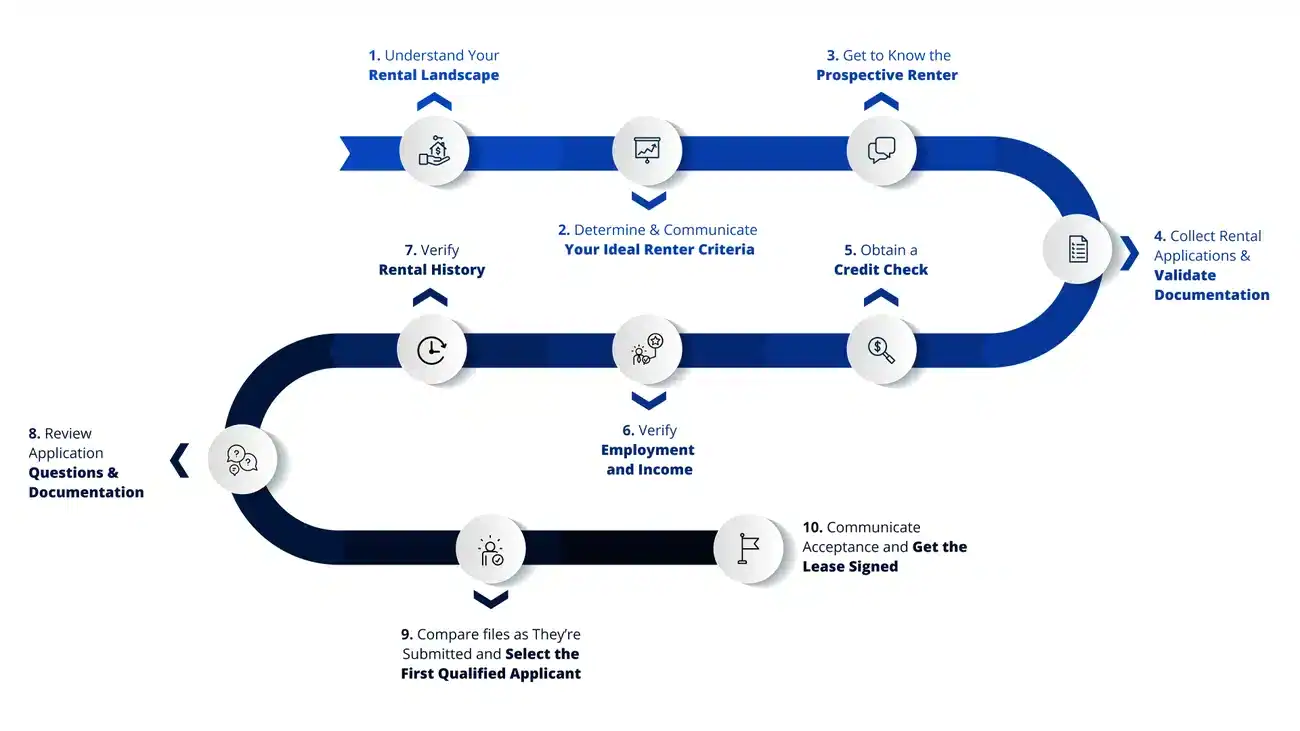
Image Source: Intellirent
A systematic tenant screening procedure protects your investment property from costly mistakes. Professional Jupiter property managers follow a methodical approach that balances thoroughness with efficiency to identify qualified applicants with unwavering precision.
Collect complete applications and fees
Effective tenant screening begins with a meticulously designed rental application. Your application form must capture essential information including:
- Personal details and government-issued identification (e.g., driver’s license, passport).
- Current and previous addresses with landlord contact information.
- Employment history and income sources.
- References (personal and professional).
- Authorization for background and credit checks.
Jupiter landlords can charge application fees without statutory limitations, as Florida law doesn’t cap these amounts. Most Florida application fees typically range between $50-$125 per applicant. These fees cover actual screening report costs while deterring unserious applicants—a practical filtering mechanism.
Crucial Step: Written Consent
Obtaining written consent from applicants before conducting any background checks is both a legal requirement and provides protection against potential disputes. Your application should clearly state that fees are non-refundable, even if the application is denied. This transparency prevents misunderstandings and establishes professional boundaries from the outset.
Verify identity and income
Identity verification serves as your first line of defense against rental fraud. Professional screening services verify applicants’ identities by matching their Social Security Numbers against supplied information. This step prevents identity theft and confirms you’re evaluating the correct person’s records—a critical validation often overlooked by inexperienced landlords.
Income verification requires examining multiple documentation sources:
- Recent pay stubs (at least 2-3 months).
- W-2 forms or tax returns (for the past 1-2 years).
- Bank statements showing consistent deposits.
- Offer letters for new employment.
- Proof of other income (e.g., alimony, child support, retirement benefits).
For self-employed applicants, request tax returns and bank statements showing business income. Direct employer contact confirms job position, salary, and employment duration. Advanced verification services can compare self-reported income with actual figures from credit bureau data. This cross-referencing significantly reduces the risk of income fraud.
Run credit, eviction, and background checks
Rigorous screening includes three critical reports that provide essential insight into tenant reliability:
- Credit Report: Obtain a credit report showing payment history, credit score, debt levels, and financial judgments. Jupiter landlords typically look for scores above 600, focusing on payment patterns rather than just numerical ratings. Payment history reveals behavioral patterns that predict future rent collection success.
- Eviction Search: Conduct a thorough eviction search covering both Palm Beach County records and national databases. This reveals previous eviction filings, unlawful detainers, and monetary judgments. Eviction history is the strongest predictor of future tenancy problems.
- Criminal Background Check: Perform criminal background checks across national and state-level records. These screenings examine over 200 million records for felonies, sex offenses, and other relevant criminal history. Most Jupiter property managers screen for both recent and serious offenses while evaluating them contextually.
Most screening reports are completed within 1-3 days, depending on applicant responsiveness and timing (weekends/holidays may delay results).
Evaluate results using consistent standards
When reviewing screening results, Jupiter landlords must apply identical standards to all applicants to avoid fair housing violations. Evaluate applications against your pre-established criteria rather than making case-by-case exceptions. Consistency is your strongest defense against discrimination claims.
Pay particular attention to these warning signs:
- Prior evictions (especially recent ones or multiple instances).
- Credit scores significantly below your minimum threshold.
- Serious criminal convictions relevant to tenancy (e.g., violent crimes, property damage).
- Unverifiable income or employment.
- Incomplete or inconsistent application information.
Document your decision-making process thoroughly, noting specific reasons for approval or denial based on objective criteria. If you reject an applicant due to credit information, you must provide an Adverse Action notice including the screening service’s contact details. Meticulous documentation protects your legal standing.
Expert Assistance for Tenant Screening
If you’d like expert help in screening tenants for your rental, speak to an InvestPro Properties leasing expert today. Professional property managers maintain current screening protocols that adhere to all Jupiter-specific regulations while identifying qualified tenants efficiently.
Consistency remains your best defense against discrimination claims. Apply identical standards to every application, maintain thorough documentation, and focus exclusively on objective factors related to tenancy performance.
Avoid Common Screening Mistakes
Even meticulous Jupiter landlords frequently encounter screening traps that lead to costly legal issues and problematic tenancies. Recognizing these critical pitfalls proactively safeguards your rental investment and maintains an efficient selection process. These operational errors often prove more expensive than most landlords anticipate—particularly when they result in discrimination claims or problematic tenant placements.
Inconsistent application of criteria
Applying different standards to different applicants represents the most dangerous mistake Jupiter landlords make during tenant screening. This inconsistency unequivocally undermines your selection process while potentially exposing you to discrimination claims and legal action. Legal disputes related to screening inconsistencies become both time-consuming and expensive—outcomes every rental property owner should actively work to prevent.
Consequence of Inconsistency:
Inconsistent application of screening criteria is a primary cause of fair housing lawsuits, leading to significant fines, legal fees, and reputational damage. Objectivity and uniformity are non-negotiable.
Maintaining unwavering consistency requires:
- Creating a written screening policy detailing your specific criteria.
- Utilizing a standardized checklist for each applicant without exception.
- Reviewing applications in identical sequence, giving equal consideration to each element.
- Training anyone involved in your screening process on proper procedures and legal requirements.
Emotional decisions or personal biases have absolutely no place in professional tenant screening. Your protection against potential discrimination claims comes through objective, uniform application of predetermined standards. This disciplined approach is paramount for legal defensibility.
Ignoring local ordinance updates
Jupiter and Palm Beach County regularly modify rental regulations, yet many landlords remain unaware of these changes until facing compliance issues. Recent Jupiter Island ordinances demonstrate that even municipalities within the same county may implement distinct requirements affecting screening practices.
Staying current with Jupiter-specific ordinance updates requires:
- Regular review of municipal websites for regulatory changes.
- Membership in local landlord associations that provide compliance updates.
- Periodic consultation with property management professionals familiar with Jupiter’s evolving rental landscape.
- Subscribing to legal updates or newsletters from reputable sources.
For 2025, pay particular attention to Jupiter’s implementation of Florida’s reusable tenant screening report legislation taking effect July 1, 2025. This legislation will significantly alter how application fees and screening reports can be handled.
Failing to document decisions properly
Inadequate documentation represents another critical mistake that undermines your tenant screening process. Federal law requires landlords to provide specific notifications when denying applications based on screening reports, including contact information for the reporting company and explaining the applicant’s right to dispute information.
Your Legal Shield: Documentation
Meticulous documentation serves as your primary defense in any legal challenge. It demonstrates due diligence, adherence to fair housing laws, and objective decision-making, protecting your investment from costly disputes.
Create an unshakeable paper trail by:
- Maintaining detailed records of all screening decisions and justifications.
- Using standardized checklists to document your evaluation process meticulously.
- Providing proper adverse action notices when required by law.
- Securely storing all application materials and screening results with appropriate retention policies (typically 3-5 years).
Professional property managers maintain robust documentation systems that protect Jupiter landlords while ensuring full compliance with ever-changing regulations. This systematic approach significantly reduces legal exposure and administrative burden. If you need expert assistance with screening tenants for your rental, InvestPro Properties offers specialized leasing expertise tailored to Jupiter’s unique regulatory environment.
Protect Tenant Rights and Stay Compliant
Protecting tenant rights throughout the screening process safeguards Jupiter landlords from potential legal complications while maintaining ethical business practices and ensuring robust regulatory compliance.
Written consent and adverse action notices
Federal regulations mandate that Jupiter landlords obtain written authorization before running any background or credit checks. This consent must appear on a separate form clearly outlining what information will be verified. Strict adherence to these federal requirements is not merely advisable but absolutely crucial to avoid significant legal exposure and potential fair housing violations that can result in substantial penalties.
Mandatory Requirement: Adverse Action Notices
When denying an application based on screening results, you must provide an adverse action notice that includes specific, statutorily required elements. This notice must contain the name and contact information of the screening company used, a clear statement explaining the applicant’s right to obtain a free copy of their report within 60 days, notification of their right to dispute inaccurate information, and specific reasons for denial rather than vague explanations. Failure to provide proper adverse action notices exposes landlords to significant liability under federal consumer protection laws.
How to handle disputes and report errors
Should applicants question information in their screening reports, Florida law establishes a structured dispute resolution process that landlords must follow meticulously. Consumer reporting agencies must investigate disputes within 30 days, removing or correcting unverifiable information to maintain accurate records.
Jupiter landlords must establish clear, documented procedures for dispute management:
- Accepting written disputes from applicants through designated channels.
- Forwarding disputes promptly to appropriate screening companies.
- Documenting all communication throughout the process with timestamps and outcomes.
- Reconsidering applications objectively if errors are confirmed through the investigation process.
This systematic approach protects both tenant rights and landlord interests while ensuring full compliance with consumer protection regulations.
Data privacy and secure recordkeeping
Florida law requires landlords handle all personal and financial information with utmost confidentiality. Maintain secure, encrypted systems for storing application materials, especially those containing sensitive data like Social Security numbers or detailed financial records. This level of data protection is expected by regulatory authorities and essential for preventing identity theft or privacy breaches.
Security Best Practice: Data Protection
Implement strong password policies, restrict access to sensitive data, and consider using secure cloud storage solutions. Regularly review your data security practices to mitigate risks and comply with privacy regulations.
Retain comprehensive documentation of your screening decisions, including original applications, complete screening reports, signed consent forms, and any adverse action notices issued. This meticulous paper trail proves your compliance with fair housing regulations and provides essential defense against potential discrimination claims or regulatory investigations. Proper recordkeeping transforms complex legal requirements into manageable administrative processes that protect your investment.
Need Expert Assistance with Compliance?
Need expert assistance with compliant screening documentation? InvestPro offers Jupiter landlords customized forms that meet all regulatory requirements while protecting your investment property and ensuring seamless compliance with evolving tenant protection laws.
Conclusion
Effective tenant screening represents the fundamental defense against problematic occupancies in Jupiter, Florida. This guide has presented a systematic framework for identifying qualified applicants while maintaining rigorous legal compliance. Strategic screening practices protect your investment from the devastating financial consequences that accompany poor tenant selection—consequences that frequently exceed thousands of dollars in lost rent and legal expenses.
Jupiter landlords must skillfully maneuver through an intricate regulatory environment where Federal Fair Housing laws intersect with Florida-specific statutes and local Palm Beach County ordinances. This complex legal framework demands unwavering attention to procedural compliance. Failure to meet these requirements exposes landlords to significant liability risks and potential discrimination claims.
Clear, defensible screening criteria form the operational backbone of successful tenant selection. Income thresholds, credit score standards, rental history verification, and criminal background evaluations must be applied consistently across all applicants. These objective standards simultaneously identify reliable tenants and provide robust legal protection against discriminatory practices.
Meticulous documentation throughout the screening process creates an essential paper trail that safeguards landlord interests. Thorough application forms, written consent authorizations, proper fee disclosures, and adverse action notices establish the evidence necessary to defend against disputes or legal challenges.
Professional property management offers invaluable expertise for Jupiter landlords seeking to optimize their screening processes. InvestPro Properties maintains current knowledge of Jupiter’s evolving rental regulations while implementing proven tenant selection protocols that protect your investment.
The paramount principle remains consistency in applying screening criteria to every applicant. Uniform standards, thorough record-keeping, and adherence to current regulations will secure qualified tenants who fulfill their lease obligations, maintain property condition, and pay rent punctually. This disciplined approach transforms tenant screening from a potential liability into a powerful investment protection strategy.
Key Takeaways
Master these essential Jupiter tenant screening strategies to protect your rental investment and avoid costly tenant mistakes:
- Apply the 3x rent rule consistently – Require applicants to earn at least three times monthly rent in gross income to ensure they can comfortably afford payments.
- Establish clear, written screening criteria – Document minimum credit scores (typically 600-650), income requirements, and background check standards to defend against discrimination claims.
- Follow Florida’s disclosure requirements – Obtain written consent before screening, provide adverse action notices when denying applications, and maintain transparent fee policies.
- Document every screening decision thoroughly – Keep detailed records of applications, reports, and justifications to protect against legal disputes and fair housing violations.
- Stay current with Jupiter-specific regulations – Monitor local ordinance updates, especially Florida’s new reusable screening report law taking effect July 1, 2025.
Effective tenant screening requires balancing thorough evaluation with legal compliance. By implementing consistent standards and maintaining proper documentation, Jupiter landlords can identify reliable tenants while avoiding the financial devastation that comes with problematic renters who stop paying or damage property.
FAQs
Q1. What are the key components of a comprehensive tenant screening process in Jupiter, Florida? A comprehensive tenant screening process in Jupiter typically includes verifying income (using the 3x rent rule), checking credit scores (usually looking for 600+ scores), reviewing rental history and eviction records, and conducting criminal background checks. It’s crucial to apply these criteria consistently to all applicants and maintain thorough documentation of the screening process.
Q2. Are there specific laws or regulations in Jupiter that landlords need to be aware of when screening tenants? Yes, Jupiter landlords must comply with federal Fair Housing laws, Florida state regulations, and local Palm Beach County ordinances. Key considerations include obtaining written consent before running background checks, providing adverse action notices when denying applications based on screening results, and staying updated on local ordinance changes, such as the new Florida reusable tenant screening report law taking effect in July 2025.
Q3. How can landlords in Jupiter protect themselves from discrimination claims during the screening process? To protect against discrimination claims, Jupiter landlords should establish clear, written screening criteria and apply them consistently to all applicants. It’s important to focus on objective factors related to tenancy performance, document all screening decisions thoroughly, and avoid making exceptions or emotional decisions. Maintaining a paper trail of all applications, reports, and communications is also crucial.
Q4. What are some common mistakes Jupiter landlords should avoid when screening tenants? Common screening mistakes include inconsistently applying criteria to different applicants, ignoring updates to local ordinances, and failing to properly document screening decisions. Landlords should also be cautious about making subjective judgments or allowing personal biases to influence their decisions. It’s important to stay informed about changing regulations and maintain a standardized, objective screening process.
Q5. How long should landlords in Jupiter retain tenant screening records? While there’s no specific timeframe mandated by Florida law, it’s generally recommended that Jupiter landlords retain comprehensive documentation of their screening decisions, including applications, reports, consent forms, and any adverse action notices, for at least 3-5 years. This documentation serves as a defense against potential discrimination claims and demonstrates compliance with fair housing regulations.
Florida Property Management Expertise
Monty M., President/CEO of InvestPro Properties, is a Florida Property Management Expert with over 27 years of experience helping landlords across West Palm Beach, Miami, Tampa, and Orlando with tenant screening, lease compliance, and risk mitigation.
Backed by a statewide team with deep experience from Port St. Lucie to Fort Lauderdale/Miami, West Palm Beach, and Tampa — and now expanding into Orlando and Jacksonville — InvestPro delivers consistent results through proven screening, documentation, and claims coordination methods. Our expertise in Florida landlord-tenant law and network of trusted local vendors help landlords minimize risk, maximize returns, and protect their investments.
Schedule a Consultation Learn More About Our Lease & Screening Services