

Tampa Multi-Family Investment Guide 2025: Apartment Complex Trends, ROI & Market Analysis
The Tampa multi-family market in 2025 is at a pivotal inflection point, with shifting rent dynamics, absorption patterns and a near-term new supply pipeline that together determine investor outcomes for apartment complexes. This guide explains what those market forces mean for Tampa multifamily investments, how to calculate realistic ROI for Class A–C assets, and which neighborhood dynamics will most directly affect valuation and exit multiples. Investors and owners facing rising operating costs, insurance and competitive leasing environments need actionable tactics to protect and grow net operating income (NOI); this article provides practical formulas, value-add levers, and operational responses that preserve cash flow and asset value. You will find data-driven trend highlights, a ranked set of submarkets with comparison tables, worked ROI examples using Tampa-specific inputs for 2025, and a clear discussion of when to engage professional property management. The content integrates best-practice operational measures and selective examples of how a professional manager like InvestPro Properties Inc. applies technology, tenant guarantees and KPI-driven operations to improve occupancy and NOI while keeping the focus on investor decision-making throughout.
Why Trust Our Tampa Multifamily Insights
At InvestPro Properties, Inc., we’ve been helping property owners and investors in the Tampa Bay area for over 27 years. Our team includes licensed leasing agents and board-certified realtors who specialize in multifamily properties. Louie B., one of our senior experts, has 14 years of experience managing 150–200+ unit apartment complexes, giving him unparalleled insight into tenant placement, occupancy optimization, and long-term ROI.
Our Tampa multifamily market analysis combines real-world operational experience with data on rental trends, property performance, and investment metrics, ensuring guidance that is accurate, actionable, and tailored to Tampa’s apartment and small-to-mid-size multifamily market.
Investors who implement our strategies consistently see improved rental performance, reduced vacancy, and stronger portfolio growth. With InvestPro Properties, you’re working with professionals who know both Tampa and the operational realities of multifamily investing in Florida.
What Are the Key Tampa Multi-Family Market Trends in 2025?
Tampa’s multi-family market in 2025 is defined by moderate rent growth, variable vacancy by submarket, and a concentrated new-construction pipeline that creates near-term absorption pressure in some corridors. Rent growth continues to vary by property class—with Class C and value-add assets often outpacing Class A in percentage increases—while overall metro vacancy hovers near pre-2024 levels but diverges sharply between urban core and suburban submarkets. These trends affect cap rates and underwriting assumptions because NOI sensitivity to modest rent moves can change projected cash-on-cash returns materially. Understanding rent gradients, vacancy dispersion and the timing of completions is therefore essential before underwriting acquisitions or capital improvements.
The following bullets summarize the most investor-relevant statistics and their implications.
- Rent growth: Moderate metro rent growth year-over-year with stronger percentage increases in Class C/value-add assets.
- Vacancy variance: Overall vacancy near historical averages but higher in new-construction submarkets; established neighborhoods show tighter occupancy.
- Supply timing: Concentrated completions in select submarkets create short-term absorption risk and localized concession pressure.
- Investor implication: Underwrite conservatively on near-term rent growth and stress-test NOI for a 3–6 month slower lease-up in affected submarkets.
Investors monitoring these metrics should pair market-level trend analysis with property-level lease-roll detail to anticipate rent capture potential and timing of stabilization. For practical execution, professional managers track rent curves and absorption weekly and execute targeted leasing campaigns; InvestPro Properties Inc. uses data-driven pricing and listing syndication across 250+ channels to compress vacancy life cycles while preserving rent.
How Is Rent Growth Shaping Tampa’s Apartment Market?
Rent growth in Tampa for 2025 is driven by class-specific demand shifts, household formation patterns, and the localized impact of new supply; Class B/C units often show stronger percentage rent increases where cost-sensitive renters trade down or seek renovated value. This mechanism raises NOI faster for value-add plays than for stabilized Class A assets, because percentage uplift on lower base rents can translate to outsized NOI improvements after renovation-driven rent premiums. Operationally, capturing that uplift requires active leasing, unit-turn renovation playbooks and dynamic pricing that reflect micro-submarket elasticity. Understanding class-level rent velocity helps investors decide whether to pursue interior upgrades or amenity investments to accelerate rent capture and improve valuation multiple on sale.
- The next paragraph will show how vacancy and absorption metrics interact with rent growth to determine near-term leasing strategy and underwriting risk.
What Are the Current Vacancy and Absorption Rates in Tampa?
Overall vacancy in Tampa shows pockets of tightness in established neighborhoods while newer developments face a longer lease-up, producing mixed net absorption numbers across submarkets. Net absorption remains positive metro-wide but is concentrated in submarkets adjacent to major employment nodes and transit corridors, which helps sustain asking rents in those micro-markets. For investors, the critical mechanism is the relationship between absorption and new completions: where completions outpace absorption, concessions and longer vacancy loss windows appear, compressing short-term NOI. Operational responses include targeted marketing, limited-time incentive structures, and pricing segmentation to protect revenue while avoiding unsustainable concession levels.
- The following sections identify which submarkets are showing the strongest demographic and economic growth that underpin these absorption differences.
Which Tampa Neighborhoods Offer the Best Multi-Family Investment Opportunities?
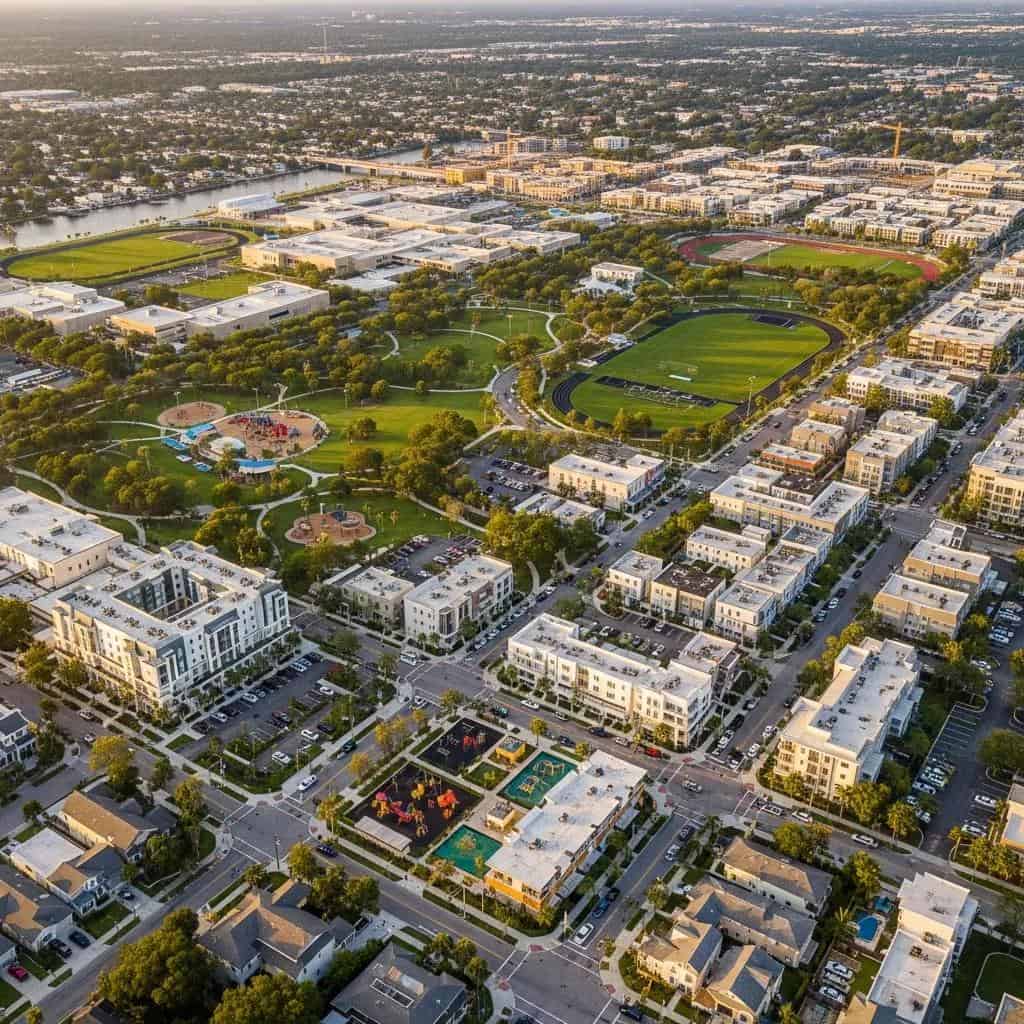
Selecting the right Tampa submarket is a primary determinant of long-term ROI because neighborhood attributes such as population and job growth, access to amenities, and development intensity shape both rent trajectory and resale cap-rate. Top submarkets combine employment access, constrained new supply and favorable demographic trends—conditions that typically support rent appreciation and lower volatility in occupancy.
Below is a comparative table that helps investors weigh population and job growth against rent pressure and vacancy to pick locations aligned with their risk-return profile.
This comparison highlights that urban-core and established neighborhood pockets often combine stronger rent pressure and lower vacancy, while some suburban corridors face higher vacancy during concentrated completions. Investors seeking stabilized cash flow may prefer Westshore; value-add buyers targeting rent uplift often focus on emerging pockets like Seminole Heights.
When evaluating submarkets, consider that professional management experience in the specific neighborhood shortens lease-up and reduces concessions. InvestPro Properties Inc. lists local case experience across Tampa and Greater Tampa Bay submarkets and applies targeted marketing and tenant screening adapted to each neighborhood’s demand profile.
What Tampa Submarkets Show Strongest Population and Economic Growth?
Submarkets near major employment centers and improved transportation nodes show the strongest combined population and job growth, driving sustained demand for multifamily housing. Population growth increases household formation while job growth provides the income base that supports higher rents; the combination yields both occupancy resilience and rent appreciation. Catalysts such as new corporate relocations, infrastructure projects and mixed-use developments amplify these effects, and investors should map these catalysts to expected lease-up timelines when underwriting acquisitions. Quantifying these dynamics at the submarket level allows for realistic assumptions about rent capture speed and stabilization periods.
- The subsequent section will connect these neighborhood dynamics to direct effects on ROI and resale multiples.
How Do Neighborhood Trends Impact Apartment Complex ROI?
Neighborhood dynamics influence ROI through two primary mechanisms: direct rent uplift that increases NOI and cap-rate movement at disposition driven by perceived market strength. A neighborhood showing accelerating employment and amenity investment typically compresses cap rates at sale, increasing sale proceeds beyond NOI growth alone. Conversely, neighborhoods with emerging supply risk may see cap-rate expansion if demand softness persists. For example, a targeted 5% rent uplift from interior renovations in a strengthening submarket can translate into a disproportionate increase in valuation if the cap-rate compresses by 25 basis points at exit. Operational choices—unit mix shifts, targeted amenity spend, and leasing execution—must therefore align with neighborhood trajectories to maximize ROI.
- Next, we provide concrete ROI calculation methods and worked examples that use these neighborhood-driven assumptions.
How Can Investors Calculate and Maximize ROI for Tampa Multi-Family Properties in 2025?
Calculating ROI for Tampa apartment investments requires clear formulas, realistic Tampa-specific inputs for rents, expenses and financing, and sensitivity scenarios for rent and vacancy swings; common metrics include cap rate, cash-on-cash return and IRR. These methods connect a property’s rent roll and expense structure to investor returns and provide a framework to test value-add strategies.
ROI methods, inputs and example outcomes:
This table shows how the same NOI figures produce different investor metrics depending on leverage and timing; investors should model multiple scenarios including conservative rent growth and a slower lease-up to capture risk.
To materially improve ROI, operational strategies that increase effective rents, reduce turnover and control expenses are most effective. Examples include targeted unit interior renovations, dynamic pricing engines, and vendor management to lower maintenance costs; the next subsection outlines practical calculation steps and common pitfalls.
What Are the Methods to Accurately Calculate ROI on Tampa Apartment Investments?
Accurate ROI calculation begins with a clean rent roll and expense ledger, then applies formulas for cap rate, cash-on-cash and IRR using consistent assumptions about vacancy, concessions and stabilizing rent. Start by normalizing NOI (add back one-time items, use market-level management fees), then calculate cap rate as NOI divided by purchase price. Cash-on-cash divides annual cash flow after debt service by initial equity; IRR models multi-year cash flows and the terminal sale. Common pitfalls include using optimistic absorption timelines, underestimating turnover costs, and ignoring submarket-specific insurance or property tax trends. A disciplined sensitivity table that stresses rent down 5–10% and vacancy up one to two points helps validate resilience of projected returns.
- The following section details which value-add strategies produce the biggest ROI uplift in Tampa markets.
Which Value-Add Strategies Enhance ROI in Tampa Multi-Family Properties?

High-impact value-add strategies in Tampa prioritize upgrades that deliver rent premiums quickly and at controlled cost—interior unit renovations, kitchen/bath updates, and selective amenity enhancements that align with tenant demand. Operational changes such as revised tenant screening to reduce eviction risk, dynamic pricing to capture market rents, and preventive maintenance programs that reduce unexpected repair spend also improve NOI. Prioritize investments with short payback periods (often 12–36 months) and measure uplift via lease-roll comparisons and market rent surveys. Compliance with permitting and insurance requirements must be part of renovation planning to avoid costly delays that erode projected returns.
Top value-add tactics to consider:
- Interior unit upgrades: Target kitchens, baths and flooring for the highest rent premium.
- Leasing and pricing optimization: Use dynamic pricing to reduce vacancy days and capture market moves.
- Maintenance & vendor management: Implement preventive maintenance schedules and no-markup vendor sourcing to control expense lines.
Each tactic should be modeled into ROI sensitivity scenarios to verify expected uplift versus execution risk.
Why Is Professional Property Management Crucial for Tampa Multi-Family Investment Success?
Yes — professional property management is crucial because it directly impacts NOI, vacancy timing, and operational risk, which together alter investor returns and exit valuations. Professional managers improve leasing speed, optimize rent capture through pricing algorithms, and reduce turnover costs through efficient maintenance and tenant screening. They also provide transparent KPI-driven reporting that enables investors to monitor performance and adapt strategy quickly.
Below is an EAV-style impact table mapping core services to measurable effects on NOI and vacancy.
These quantified impacts illustrate how targeted operational execution converts into improved cash flow and lower risk for investors.
- The following subsection describes how InvestPro Properties Inc. operationalizes these levers in Tampa and Greater Tampa Bay.
How Does InvestPro Properties Inc. Optimize Tampa Apartment Complex Performance?
InvestPro Properties Inc. applies a KPI-driven operations model that combines tenant marketing across 250+ listing channels, AI leasing technology, hybrid on-site/remote staffing and transparent financial reporting to improve occupancy and NOI. Their service guarantees—such as a 28-day guaranteed vacancy fill time and a Tenant Performance Guarantee—are designed to align manager incentives with investor outcomes by shortening lease-up and reducing bad-actor tenant placements. Operational tactics include attorney-prepared lease management, tenant screening protocols, and maintenance coordination with no markup on vendor bills to preserve owner cash flow. These combined features illustrate how professional management converts market trends and building-level actions into measurable NOI improvement while maintaining transparency for owners.
- The next subsection provides screening and maintenance practices that underpin lower vacancy and reduced expense volatility.
What Tenant Screening and Maintenance Practices Reduce Vacancy and Costs?
Rigorous tenant screening that balances income, credit and eviction history with objective scoring reduces turnover and minimizes eviction-related downtime; screening should include verifiable income ratios, credit thresholds and prior rental history checks. Preventive maintenance schedules, routine inspections and a vetted vendor network with no maintenance mark-up lower unexpected repair costs and speed turnaround between tenancies. Standardized move-in/move-out inspections combined with clear tenant onboarding reduce disputes and shorten turnaround days. Together, effective screening and maintenance reduce vacancy loss, stabilize rent collections and protect NOI against operational shocks.
Tenant screening and maintenance checklist:
- Income verification and rent-to-income thresholds: Ensures sustainable tenant payments.
- Credit and eviction history checks: Reduces placement of high-risk tenants.
- Preventive maintenance schedules: Limits major repairs and shortens downtime.
Properly executed, these practices produce measurable reductions in vacancy and maintenance expense that improve investor returns.
What Are the Tampa Multi-Family Development and Regulatory Outlooks for 2025?
The development outlook for Tampa in 2025 centers on a significant but concentrated new-construction pipeline that will affect submarkets unevenly, producing localized supply pressure while leaving other areas supply-constrained and supportive of rent growth. Investors must weigh the timing of completions against net absorption and consider timing strategies—acquire before stabilization to capture value-add upside, or buy stabilized assets in constrained submarkets for lower operational risk. Regulatory and permitting considerations—especially insurance, flood zone exposure and local landlord-tenant ordinances—also influence underwriting and renovation planning.
The next subsection quantifies the supply dynamics and practical timing tactics.
How Will New Construction Affect Tampa’s Apartment Market Supply?
Units completing in 2025 are concentrated in a handful of submarkets, creating temporary supply gluts that can extend lease-up periods and increase concessions in those corridors. Comparing absorption rates to projected completions at the submarket level reveals where leasing competition will intensify and where demand is likely to absorb new stock more rapidly. Investors can mitigate supply shocks by focusing acquisitions on submarkets with steady job growth and constrained pipeline, staggering capital improvements to align with demand recovery, and negotiating construction contingency plans when pursuing ground-up or conversion projects. Timing acquisitions around lease-up windows and staging renovations helps protect NOI during periods of heightened new supply.
- The following subsection outlines legal and regulatory items investors should include in their due diligence checklist.
What Legal and Regulatory Factors Should Tampa Investors Consider?
Investors should maintain a concise regulatory checklist that covers landlord-tenant law nuances, insurance requirements (including flood and windstorm considerations), zoning and permitting constraints for renovations, and compliance with local code enforcement. Understanding local ordinance updates and insurance market shifts is essential because increased costs or regulatory changes can materially affect operating expense assumptions. Engaging local counsel for complex transactions, verifying permit pathways for planned renovations, and confirming insurance availability for multifamily assets are all prudent steps that reduce transaction and execution risk. A proactive compliance approach shortens project timelines and prevents unanticipated cost overruns.
Regulatory due-diligence checklist:
- Landlord-tenant law review: Confirm local notice and eviction procedures.
- Insurance & flood exposure assessment: Verify coverage availability and pricing impacts.
- Permitting pathway & code compliance: Ensure planned upgrades meet local permitting requirements.
These precautions help manage legal and operational risks that otherwise erode expected returns on Tampa multifamily projects.
ð Book your free multifamily consultation
Planning a multifamily investment in Tampa?
Schedule a free consultation to review local market trends, ROI expectations, and management strategies tailored to your property.